

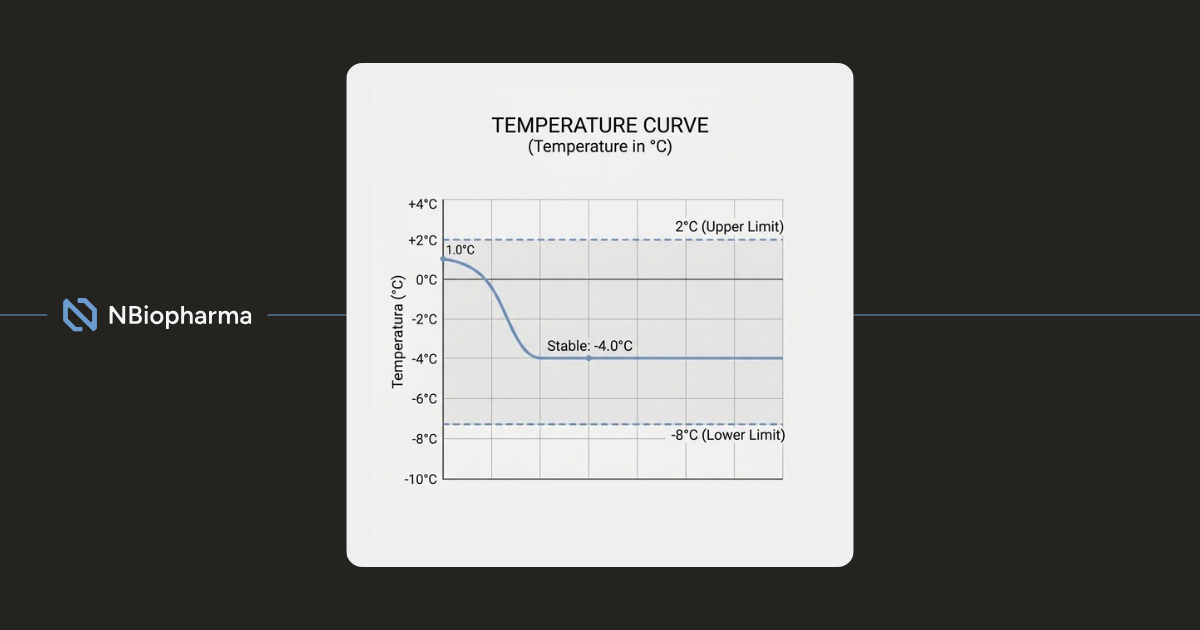
Every pharmaceutical cold chain is designed to prevent temperature excursions. But a well-run cold chain is also designed for the moment one happens anyway. A flight delay, a failed cooling unit or a package left too long on a dock can push a shipment outside its validated range, and what happens in the hours that follow often matters as much as the excursion itself.
This article explains what counts as a temperature excursion in pharmaceutical transport, how it should be handled under EU Good Distribution Practice (GDP), and who actually decides whether the product can still be used.
What Counts as a Temperature Excursion
A temperature excursion is any period during which a product is exposed to temperatures outside the range defined for its storage or transport. For a refrigerated product labelled for 2°C to 8°C, that means any reading above 8°C or below 2°C, not only dramatic spikes. Excursions below the range are frequently underestimated: many biologics and vaccines can be damaged by freezing without any visible change in appearance.
Not every excursion means a product is lost. Manufacturers generate stability data that shows how a product behaves outside its labelled conditions, and some products can tolerate short, limited exposures. The point is that this judgment must be made on evidence, by the right party, and never assumed by whoever happens to be handling the shipment at the time.
Detection: Why Continuous Monitoring Matters
An excursion that is not detected cannot be managed. That is why GDP-oriented cold chain operations rely on continuous monitoring, typically data loggers that record temperature at set intervals throughout transit, rather than spot checks at pickup and delivery. A spot check can confirm that a product arrived at the right temperature; only a continuous record can show whether it stayed there along the way.
Good monitoring data answers three questions: how far outside the range the product went, for how long, and at which point in the journey. Without all three, neither the logistics provider nor the product owner can assess the impact or find the cause.
The First Hours: What a Compliant Response Looks Like
The EU GDP Guidelines (2013/C 343/01) require a procedure for investigating and handling temperature excursions, and expect deviations during transport to be reported to the distributor and the recipient of the affected products. In practice, a sound response usually follows the same sequence:
• Secure the product. The shipment is kept under its required conditions and segregated or placed on hold, so it cannot be used or moved on before a decision is made.
• Preserve the evidence. Monitoring data, handover records and any relevant timestamps are retrieved and protected. The logger data is the core of the investigation.
• Notify the right people promptly. The sender and the recipient are informed with the facts: the range breached, the duration and where it happened.
• Wait for a documented decision. The product is not released, returned or destroyed until the party responsible for its quality has assessed it.
What a compliant response avoids is just as important: no quiet re-cooling of the product in the hope that the excursion goes unnoticed, and no decision about usability taken at the loading dock.
Who Decides Whether the Product Can Be Used
This is one of the most misunderstood points in pharmaceutical logistics. The logistics provider detects, contains, documents and reports the excursion, but the decision on whether the product remains fit for use belongs to the party responsible for the product: typically the manufacturer or marketing authorisation holder, assessing the excursion against its stability data through its own quality system.
That division of roles protects everyone. The product owner has the data needed to judge the impact on quality; the logistics provider has the data needed to show what happened and when. A clean, complete excursion record is what allows that assessment to be quick and defensible.
Root Cause and Prevention
Once the immediate situation is resolved, the excursion becomes a quality event. Under GDP, the expectation is not only that it was recorded, but that its cause was investigated and that corrective and preventive actions were identified where appropriate. Was the packaging configuration right for the season? Was a handover delayed? Did a route carry more risk than planned? The answers feed back into procedures, packaging choices and route planning so that the same excursion does not happen twice.
How NBiopharma Approaches Temperature Excursions
NBiopharma operates under EU GDP guideline 2013/C 343/01 (SGS ES18/22872) and ISO 9001:2015 (SGS ES18/22873), with continuous temperature monitoring and documented procedures for handling and reporting deviations. Our role in an excursion is clear: protect the product, preserve the evidence, inform the right people and support the product owner’s decision with complete, traceable data.
If you are evaluating a pharmaceutical logistics partner, ask to see how their excursion procedure works in practice: who gets notified, how quickly, and what the documentation looks like. It is one of the most revealing questions you can ask about the real reliability of a cold chain.