

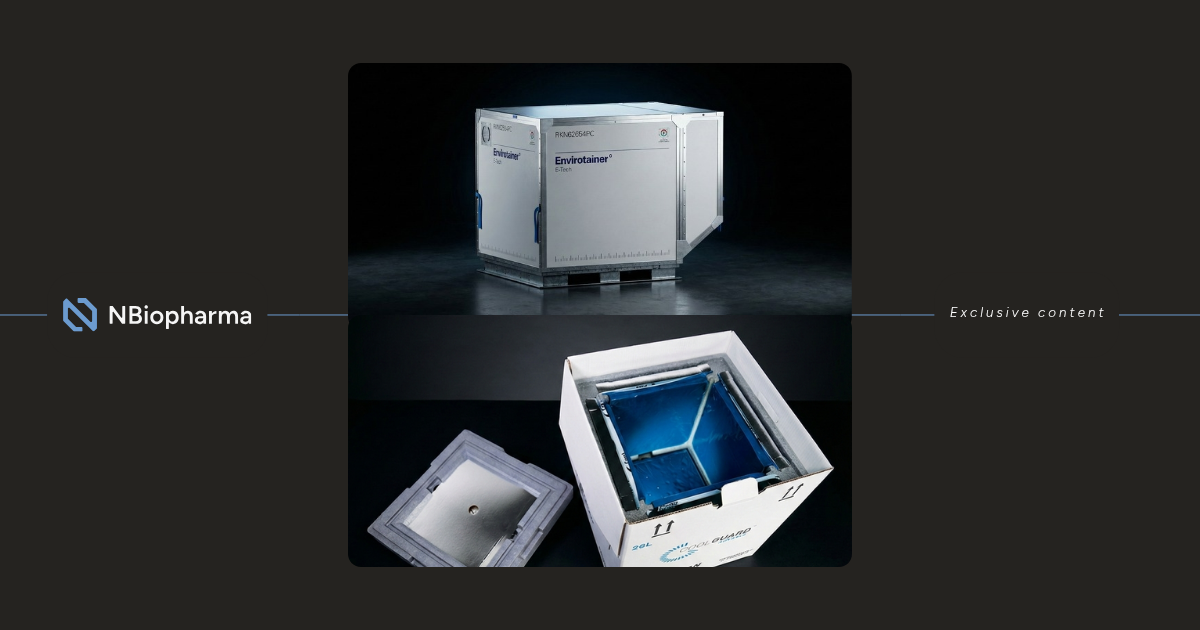
Keeping a pharmaceutical product within its validated temperature range during transport depends, above all, on what it travels in. Two broad approaches exist: passive packaging, which holds temperature without any power source, and active packaging, which uses its own cooling or heating system. Neither is universally better. The right choice depends on the product, the route, the transit time and the risks along the way.
What Passive Packaging Is
Passive packaging relies on insulation and a thermal mass to keep the contents within range for a defined period. A typical passive shipper combines an insulated box (expanded polystyrene, polyurethane or, for longer durations, vacuum insulated panels) with conditioned coolants: gel packs, phase change materials designed to hold a specific temperature, or dry ice for frozen shipments.
Passive solutions are flexible and widely used. They suit parcels and smaller consignments, work across road and air transport, and do not depend on an external power supply. Their limitation is time: each configuration is designed to protect the product for a defined duration under a defined external temperature profile. Beyond that, protection is no longer guaranteed.
What Active Packaging Is
Active packaging uses powered systems, such as containers with compressor-driven cooling and heating or refrigerated vehicle compartments, to regulate temperature actively. Many active containers used in air freight can both cool and heat, which helps when external conditions swing in either direction.
Active systems suit larger volumes, long or complex routes, and products with narrow tolerances. They usually cost more, need specific handling and power or battery management, and depend on availability on the chosen route.
How to Choose Between Them
A structured choice usually looks at several factors together:
• Product requirements: the validated range (refrigerated, controlled ambient, frozen or deep-frozen) and how sensitive the product is to excursions.
• Transit time, including realistic delays: the relevant duration is not the scheduled time, but the plausible worst case.
• Route and external conditions: seasonal temperatures at origin, destination and transfer points, and time spent on the ground.
• Volume and value: a few parcels rarely justify an active container; a full consignment of high-value biologics may.
• Handling points: every transfer is an opportunity for delay or exposure, so routes with many touchpoints need more margin.
Why Qualification Matters More Than the Box
Under EU GDP (2013/C 343/01), equipment used to maintain temperature during transport is expected to be fit for purpose and qualified. For packaging, that means evidence that a specific configuration keeps the product within range for a specific duration against defined external temperature profiles, commonly a summer and a winter profile.
A qualified configuration is only reliable if it is used exactly as qualified: the right coolants, conditioned at the right temperature for the right time, packed in the right order. Many excursions trace back not to the packaging itself, but to small deviations in how it was prepared.
Combining Both Approaches
In practice, passive and active solutions are often combined within the same supply chain. A consignment may travel by air in an active container and then be split into qualified passive shippers for the final deliveries to hospitals or clinical sites. Or a passive shipper may spend part of its journey inside a refrigerated vehicle, which reduces the load on the packaging and extends its margin.
The critical point in any combined solution is the transition between systems. Each transfer from active to passive, or from vehicle to shipper, is a handover where time outside controlled conditions can accumulate. Those transitions need to be planned, timed and documented as carefully as the main legs of the journey.
Common Mistakes to Avoid
• Using the same configuration all year round, even though winter conditions can expose refrigerated products to freezing.
• Sizing packaging for the scheduled transit time with no margin for delays at customs, transfers or the last mile.
• Incorrect pre-conditioning of gel packs or phase change materials, which can push products out of range from the very start.
• Shipping without continuous monitoring, which leaves no evidence of whether the packaging actually performed.
How NBiopharma Approaches Packaging Choices
At NBiopharma, packaging is selected shipment by shipment according to the product’s validated range, the route and the realistic transit time, and it is always paired with temperature monitoring. We operate under EU GDP guideline 2013/C 343/01 (SGS ES18/22872) and ISO 9001:2015 (SGS ES18/22873) from our Barcelona operation and our facilities at the El Prat airport cargo terminal.
If you are planning a temperature-sensitive shipment, the most useful starting point is not “active or passive?” but “what does this product need to survive the worst realistic version of this journey?” That is the conversation we are glad to have before the first shipment leaves.