

Spain sits at a specific intersection for pharmaceutical logistics: a major European manufacturing and distribution hub, a gateway to Latin America via air and sea routes, and a domestic market with its own regulatory and infrastructure characteristics. For companies moving temperature-sensitive pharmaceutical products in or through Spain, understanding how temperature-controlled freight actually works — and what varies between domestic and international movements — matters more than it might seem.
The Basics of Temperature-Controlled Freight
Temperature-controlled freight refers to the transport of goods that must be kept within a defined temperature range throughout transit — commonly refrigerated (2°C to 8°C) or frozen ranges for pharmaceutical products, though some categories require broader or narrower bands depending on the product.
This is achieved through a combination of active systems (refrigerated vehicles and containers with their own cooling units) and passive systems (insulated, validated packaging designed to hold temperature for a defined period without external power). Which approach is used typically depends on transit time, route, and the specific product’s stability profile.
Domestic vs International Cold Chain Challenges in Spain
Domestic shipments within Spain — for example, between Barcelona and Madrid — tend to face fewer regulatory hurdles than international shipments, but that doesn’t make them lower-risk from a cold chain integrity standpoint. Road distances, traffic delays, and the number of handover points between origin and destination all affect how consistently temperature can be maintained, regardless of whether a border is crossed.
International shipments add customs clearance, documentation requirements, and, depending on origin and destination, additional regulatory frameworks to satisfy. For shipments moving by air through hubs like Barcelona’s El Prat airport, the process typically involves coordination between ground handling, customs, and the airline’s own cargo acceptance procedures — each an additional point where cold chain integrity needs to be actively protected rather than assumed.
Infrastructure and Equipment That Matter
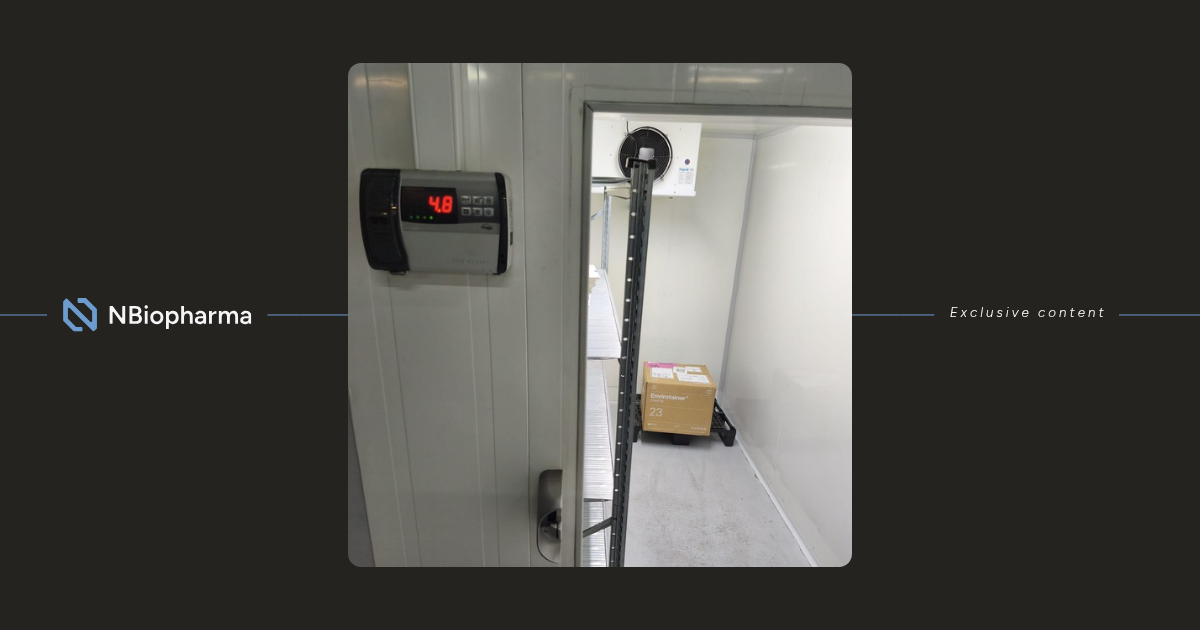
A logistics provider’s actual cold chain capability in Spain depends on several concrete elements: refrigerated vehicle fleet and validated cold storage facilities; data logger-based temperature monitoring for full-journey visibility rather than spot checks; qualified packaging validated for realistic worst-case transit times, including potential delays; and staff trained specifically in pharmaceutical handling, not general freight procedures applied to a different product category.
Relevant certifications also matter here as external validation: GDP certification (EU Guideline 2013/C 343/01) for the transport and storage of medicinal products, and ISO 9001:2015 for quality management systems more broadly.
Choosing a Temperature-Controlled Freight Partner in Spain
For pharmaceutical shippers evaluating options in Spain, useful questions include: does the provider operate their own temperature-controlled fleet and storage, or subcontract it; what monitoring evidence is provided per shipment, and in what format; how are domestic multi-stop routes (such as Barcelona-Madrid corridors) handled operationally; and what happens, procedurally, if a temperature deviation is detected mid-transit.
NBiopharma operates temperature-controlled logistics from our Barcelona operation and airport terminal facilities at El Prat, under GDP (SGS ES18/22872) and ISO 9001:2015 (SGS ES18/22873) certification. For companies moving pharmaceutical products within Spain or internationally through Spanish hubs, these are exactly the kinds of operational details we discuss directly, shipment by shipment.